


About us
Operations
Sustainability
Investor relations

Chief executive officer – ARM Ferrous
Additional information
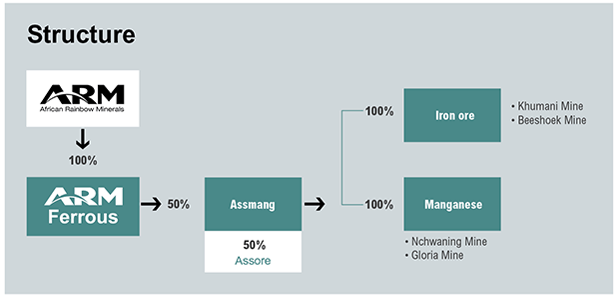
The interactive diagram below shows ARM Platinum’s ownership structure and key partnerships across mining operations, highlighting joint ventures and strategic stakeholders.
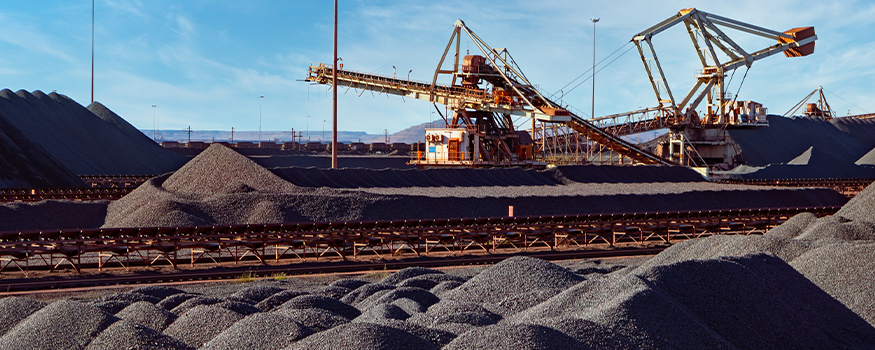
Iron ore

Open‑pit mechanised mine

2.3Mt iron ore
LoM
20 years
EMPL
3 873
LTIFR
0.15
Key

Mine/operation type

F2025 production volumes (100% basis)
LoM
Approximate life-of-mine
EMPL
Number of employees at 30 June F2025 (full‑time employees and contractors)
LTIFR
F2025 lost‑time injury-frequency rate per 200 000 man-hours
ARM’s attributable beneficial interest in Assmang operations is 50%. The other 50% is held by Assore South Africa Proprietary Limited. Assmang operations comprise the Black Rock Manganese Mine as well as Khumani and Beeshoek iron ore mines.
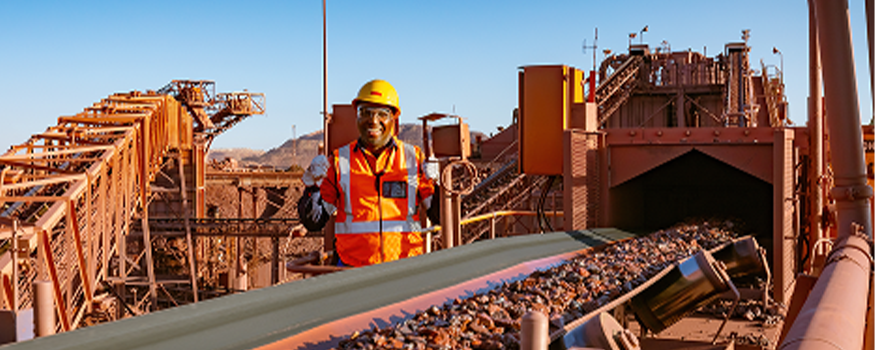
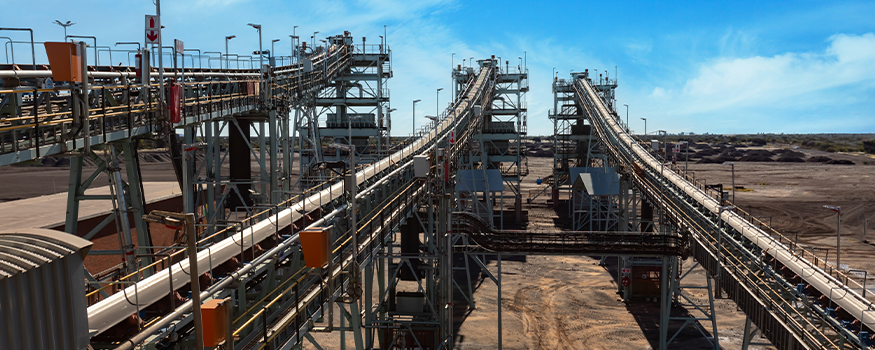
Khumani Mine is located on either side of the N14 approximately 20 kilometres south of the town of Kathu on the farms Bruce 544, King 561 and Mokaning 560. Khumani is approximately 200 kilometres west of Kimberley in the Northern Cape, at latitude 27°45’00’’S and longitude 23°00’00’’E.
The first venture into mining was as early as 1926 by Union Manganese Mines and Minerals Limited (later Manganese Corporation Limited) to extract manganese ore on Bruce and King. Mining of manganese ore on Bruce, King, Mokaning and McCarthy continued in 1935 by Associated Manganese Mines of South Africa Limited. Exploration for iron ore commenced in 1975, which included mapping, drilling and bulk sampling by the US Steel Corporation on mainly Bruce and King. From 1980 to 1987, Iscor expanded the exploration drilling and mined iron ore on Bruce as per agreement with Assmang.
From the 1990s to early 2000s various drilling campaigns were completed. In this period, an expanded ground gravity survey on the farms Bruce, King and Mokaning (BKM) was completed and the drilling of the subsequent gravity anomalies on a 200-metre grid contributed to the growth of the resource. Concurrently the infill drilling on the iron ore outcrops advanced significantly, which served as the foundation for the feasibility study for the BKM Project in 2005.
Khumani’s official mining commenced in 2007 with ore extraction on Bruce. Since 2008 exploration expanded considerably, which initially focused on infill drilling at King, but the necessity for detailed infill and grade-control drilling on both Bruce and King warranted an extensive drilling programme for the ensuing years. That included grid space drilling down to 50 metres and even 25 metres within the active mining areas. In the last few years, the emphasis was to continue the infill drilling as well as to expand the exploration towards the southern and eastern parts of Mokaning as well as the western and southern parts of King.
Iron ore
Open‑pit mechanised mine
2.5Mt Iron ore
LoM
Currently on care and maintenance
EMPL
1 172
LTIFR
0.07
Key
Mine/operation type
F2025 production volumes (100% basis)
LoM
Approximate life-of-mine
EMPL
Number of employees at 30 June F2025 (full‑time employees and contractors)
LTIFR
F2025 lost‑time injury-frequency rate per 200 000 man-hours
ARM’s attributable beneficial interest in Assmang operations is 50%. The other 50% is held by Assore South Africa Proprietary Limited. Assmang operations comprise the Black Rock Manganese Mine as well as Khumani and Beeshoek iron ore mines.
Beeshoek Mine is located on the farms Beesthoek 448 and Olyn Fontein 475, situated approximately 200 kilometres west of Kimberley in the Northern Cape province. The Beeshoek open-pit operations are situated seven kilometres west of Postmasburg located at latitude 28°30’00’’S and longitude 23°01’00’’E.
Mining of iron ore (mainly specularite) was undertaken as early as 40 000 BC on the farm Doornfontein which is due north of Beeshoek. The potential of iron ore in this region was discovered in 1909, but, due to lack of demand and limited infrastructure, this commodity was given little attention. In 1929, the railway line was extended from Koopmansfontein (near Kimberley) to service a manganese mine at Beeshoek. In 1935, the Associated Manganese Mines of South Africa Limited (Assmang) was formed. In 1964, Beeshoek Iron Ore Mine was established, with a basic hand-sorting operation. In 1975, a washing and screening plant was installed at Beeshoek Mine.
Manganese ore
Underground mechanised mine
3.8Mt manganese ore
LoM
>30 years
EMPL
4 111
LTIFR
0.14
Key
Mine/operation type
F2025 production volumes (100% basis)
LoM
Approximate life-of-mine
EMPL
Number of employees at 30 June F2025 (full‑time employees and contractors)
LTIFR
F2025 lost‑time injury-frequency rate per 200 000 man-hours
ARM’s attributable beneficial interest in Assmang operations is 50%. The other 50% is held by Assore South Africa Proprietary Limited.
Black Rock Manganese Mine encompasses Nchwaning and Gloria mines which are situated approximately 80 kilometres north-west of the town of Kuruman in the Northern Cape province of South Africa. Located at latitude 27°07’50”S and longitude 22°50’50”E, the mines are accessed via the national N14 route between Johannesburg and Kuruman, and the R31 provincial road. Nchwaning 3 and Nchwaning 2 (including graben area) shafts are situated on portions of Nchwaning 267, Belgravia 264 and Santoy 230 farms while Gloria Mine is on Portion 1 of Gloria 266. The Nchwaning and the adjoining Gloria Mining Rights are bounded by the farms Wessels 227, Dibiaghomo 226 and Dikgathlong 268 in the north, Rhodes 269, East 270 and Kipling 271 in the east, Umtu 281 and Mukulu 265 to the south.
In 1940, Assmang acquired a manganese ore outcrop on a small hillock known as Black Rock. Several large properties underlain by ore were subsequently found and acquired. Today, the Black Rock area is considered to be one of the largest and richest manganese deposits in the world. Manganese mining operations were extended and today include the Gloria and Nchwaning underground mines.