


About us
Operations
Sustainability
Investor relations
Acting chief executive officer – ARM Platinum
Additional information
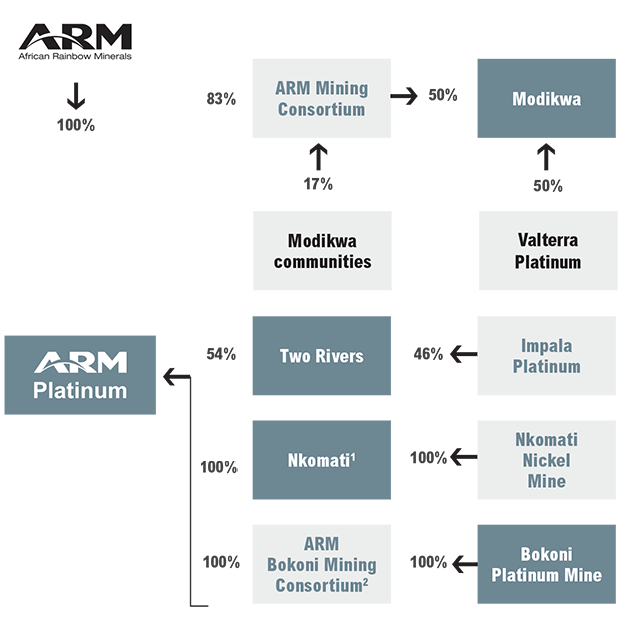
The interactive diagram below shows ARM Platinum’s ownership structure and key partnerships across mining operations, highlighting joint ventures and strategic stakeholders.
6E PGM metals

Underground mechanised mine

288 000 6E PGM ounces
LoM
21 years
EMPL
4 321
LTIFR
0.61
Key

Mine/operation type

F2025 production volumes (100% basis)
LoM
Approximate life-of-mine
EMPL
Number of employees at 30 June 2020 (full‑time employees and contractors)
LTIFR
F2020 lost‑time injury‑frequency rate (LTIFR) per 200 000 man-hours
ARM’s attributable beneficial interest in Two Rivers Platinum Mine is 54%. The remaining 46% is held by Impala Platinum Holdings Limited (Impala Platinum).


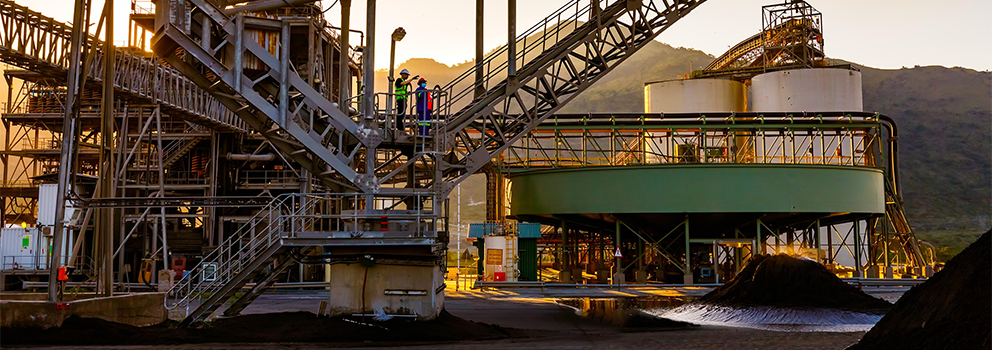
Two Rivers Platinum Mine is located in the southern sector of the Eastern Limb of the Bushveld Complex. The mine is located on the farm Dwarsrivier 372 KT and extends to portions of the farms Kalkfontein 367 KT, Tweefontein 360 KT and Buffelshoek 368 KT. At latitude 24°59’S and longitude 30°07’E, the mine is approximately 30 kilometres from Steelpoort and 60 kilometres from Mashishing, Limpopo province, South Africa. Two Rivers Platinum Mine is neighboured by Mototolo Platinum Mine and Dwarsrivier, Tweefontein and Thorncliff chromite mines.
Exploration, development and production history in the Eastern Bushveld dates from the early 1920s. During 1929, Lydenburg Platinum Areas Limited started mining activity, but no records are available.
Following the acquisition of the area by Gold Fields Mining and Development Limited, exploration started again in 1987 and was mainly directed at the Merensky Reef. Assmang Limited acquired the Dwarsrivier farm in September 1998, primarily to exploit the LG6 chromitite. During 2001, Anglovaal acquired the PGM rights on the farm from Assmang and targeted the UG2 Reef. In June 2005, after the 2004 ARM/Anglovaal merger, and following a feasibility study and period of trial underground mining, the ARM/Impala joint venture announced the approval of a 220 000 ounce per year PGM mine. As a result, an underground mine was established.
6E PGM metals
Underground mine
282 000 6E PGM ounces
LoM
19 years*
EMPL
5 089
LTIFR
0.28
Key
Mine/operation type
approximate production volumes on a 100%
LoM
Approximate life-of-mine
EMPL
Number of employees at 30 June 2020 (full‑time employees and contractors)
LTIFR
F2020 lost‑time injury‑frequency rate (LTIFR) per 200 000 man-hours
ARM’s attributable beneficial interest in Modikwa’s operations is 41.5%. 8.5% is held by the Modikwa communities and 50% is held by Rustenburg Platinum Mines (Valterra).


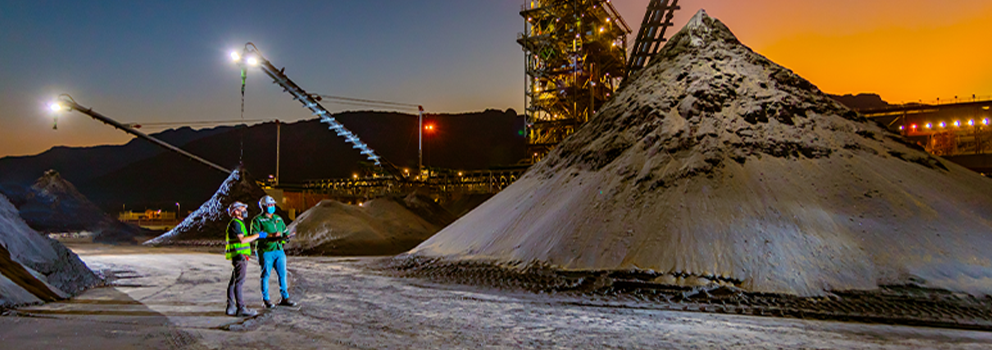
Modikwa Platinum Mine is situated approximately 15 kilometres north-west of Burgersfort along the border between the Mpumalanga and Limpopo provinces in South Africa. Located at latitude 24º40’S and longitude 30º10’E, the site is accessed via the R37 road between Polokwane and Burgersfort. The topography of the area is defined by a low‑lying broad valley which strikes due north‑south and is underlain by rock units of the upper critical zone of the Bushveld Complex.
Exploration in the area started in the mid-1920s with the discovery of the Merensky Reef. During the late 1980s, drilling was undertaken on the UG2 and Merensky reefs. In the late 1990s, a feasibility study was completed for the exploitation of the UG2 Reef. During 2001, a 50:50 joint venture agreement was signed between Rustenburg Platinum Mines and ARM Mining Consortium Limited. ARM’s effective stake in Modikwa is 41.5%, through its 83% ownership of the ARM Mining Consortium. The other 8.5% is held by the Mampudima and Matimatjatji community companies through their 17% shareholding in the ARM Mining Consortium.
6E PGM metals
Underground mechanised mine
46 000 6E PGM ounces
LoM
19 years
EMPL
2 068
LTIFR
0.55
Key
Mine/operation type
approximate production volumes on a 100%
LoM
Approximate life-of-mine
EMPL
Number of employees at 30 June 2020 (full‑time employees and contractors)
LTIFR
F2020 lost‑time injury‑frequency rate (LTIFR) per 200 000 man-hours
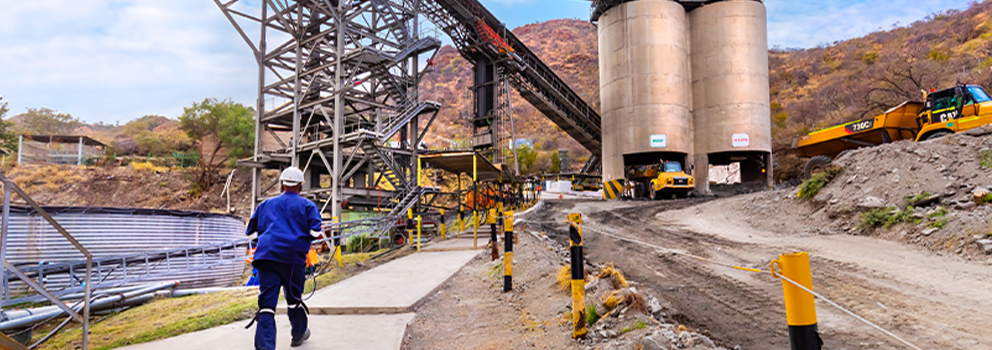
ARM’s attributable beneficial interest at Bokoni Platinum Mine is 100%. A 15% shareholding in ARM Bokoni Mine Consortium will be allocated to qualifying employees, local communities and black industrialists who will each hold 5%.
Bokoni Platinum Mine is located near Atok in the Fetakgomo Tubatse Local Municipality, within the Sekhukhune District of Limpopo Province, South Africa. The mine is situated on the Eastern Limb of the Bushveld Complex, approximately 70 km west of Burgersfort and 80–85 km southeast of Polokwane.
Operating since 1969, Bokoni Mine has undergone several significant phases of development and transformation. Mining began as a small-scale open-cast and adit operation on the Merensky Reef before transitioning to underground mining during the 1970s and 1980s. In 2008, the mine was acquired by Atlatsa Resources from Anglo American Platinum, marking a new chapter in its ownership. Operations were suspended in 2017 when the mine was placed on care and maintenance due to declining platinum group metals (PGM) prices, labour challenges, and financial pressures. In 2022, African Rainbow Minerals (ARM) acquired Bokoni Mine for R3.5 billion and launched a major redevelopment programme, signalling the mine's return to production and its renewed focus on sustainable growth, job creation, and long-term value for surrounding communities and stakeholders.